Archives: October 3, 2026

30,153 Spam Comments and One Real One: What Attacks a Tiny WordPress Site

My little WordPress blog gets a small, steady trickle of readers from search engines. In the last two months, it also got thousands of attacks.

I never thought anyone would bother. There is no shop, no user data worth stealing, and only one real comment in three years. But when I finally sat down with the server’s access logs, the picture was very different. This post walks through what I found, what it means, and what I changed.

The site and the method

The site is a small WordPress blog on ordinary shared hosting, with articles from 2023 to 2025. Two of them carry most of the traffic, each with roughly 1,100 to 1,200 visitors over the period, some of them crawlers.

I looked at the Apache access logs from 3 August to 3 October 2026 and analyzed them locally with GoAccess. No tracking scripts, no security plugin dashboards: just the raw requests the server received. All numbers below are rounded.

Requests (blue) and unique visitors (red) per day. The blue spikes are bursts of automated traffic.

On average the site served about 580 requests a day. On 27 September it got 2,460, more than four times as many, with similar bursts on 9 August and 12 September. Real readers don’t arrive like that; bots do.

Comment spam: every single day since July 2024

The loudest attacker was comment spam: about 2,600 automated comment submissions in two months. Over the blog’s lifetime, the database had collected at least 30,153 comments flagged as spam. In the same time, it received exactly one real comment, in 2023.
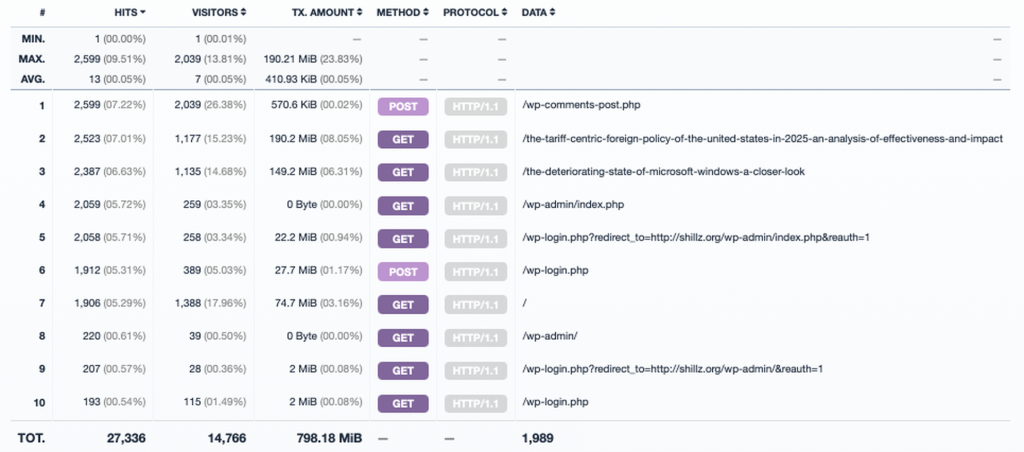
The most-requested URLs, 3 August to 3 October 2026. The comment form tops the list, ahead of my most popular article, and the admin and login pages take six of the top ten spots.

The most-requested address on my blog wasn’t an article; it was the comment form. Those 2,600 submissions came from about 2,000 different visitors in GoAccess’s count, so this wasn’t one bot but a swarm.

The first spam comment arrived in March 2023, eight weeks after launch. It was a line of keyboard mashing. For a year it stayed a trickle of a few dozen a month. Then, in summer 2024, it turned into a flood. Since 1 July 2024 there hasn’t been a single day without spam: 825 days in a row, about 36 a day, peaking at 2,009 in July 2025. The bots work around the clock; every hour of the day gets roughly the same amount.
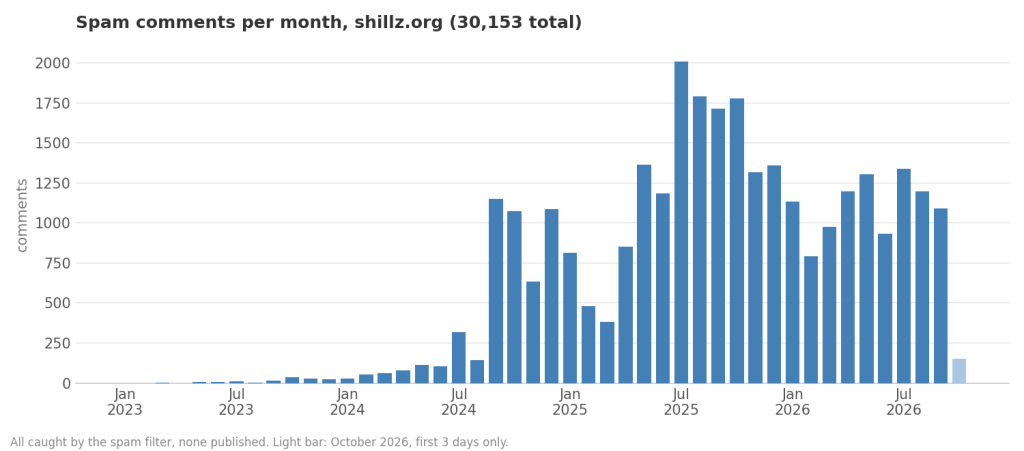
Comments flagged as spam per month. The light bar is October 2026, which covers only three days.

Almost all of it, 94%, landed on just three posts. And once the bots found a post, they kept coming back: one post from December 2023 collected spam for almost three years. 10,000 comments, to be exact.

What were they selling? Mostly fake diplomas and school certificates (30%), then online casinos and betting (19%), then local services like renovation and towing, and home detox for alcoholics. The diploma wave made up 70 to 80% of all spam from mid-2024 into early 2025, and has since disappeared; in 2026, gambling leads. 71% was in Russian, only 9% in English.

It’s mass-produced, but not copy-paste. The 30,153 comments came from 27,812 different “names”, usually a keyword plus four random letters. 99% carried at least one link, one of them 252, pointing to more than 11,600 different domains; almost 7,000 of those appeared exactly once. The English ones were the friendliest: “very good”, “awesome”, “thanks for the article”. Seventeen even greeted the site by name: “Good article Shillz”.

Antispam Bee caught all of them, and not a single one was published. Deleting them shrank the database from 32 MB to 14 MB.

Guessing passwords, and first guessing who to log in as

The second big pattern was password guessing: about 1,900 login attempts, plus around 2,000 requests poking at the admin area. These are bots working through lists of common and leaked passwords, hoping one fits.

Before guessing a password, a bot needs a username. WordPress is surprisingly willing to hand those out. A request like ?author=1 redirects to an author page named after the user, and the REST API can list users too. My logs were full of bots walking through these, one user number after another. Login guessing and username discovery go hand in hand, so blocking only one of them is half a fix.

The quiet one: application passwords

The most interesting attempt was also the quietest. On 2 October, something tried to create application passwords for user IDs 2 through 9. Application passwords are a WordPress feature that lets apps and scripts log in through the API, separately from your normal password. If an attacker can create one, they get a permanent back door that survives a password change.

Creating one normally requires being logged in as that user, so the bot was most likely hoping for a misconfiguration or a vulnerable plugin. On my site it didn’t even get that far, for a slightly embarrassing reason: the site had no HTTPS yet, and WordPress disables application passwords without it. My missing certificate accidentally protected me. I’ve since switched the site to HTTPS and turned the feature off entirely, since nothing on the blog uses it.

Scanners looking for secrets

A steady background of scanners didn’t care that the site runs WordPress at all. They asked for files that should never be public: .env files with passwords, cloud keys like serviceAccountKey.json, and leftover copies of the WordPress config file such as wp-config.php.bak or editor backup files ending in ~ or .swp. One forgotten backup file can expose a database password, and these bots check every site they find for exactly that.
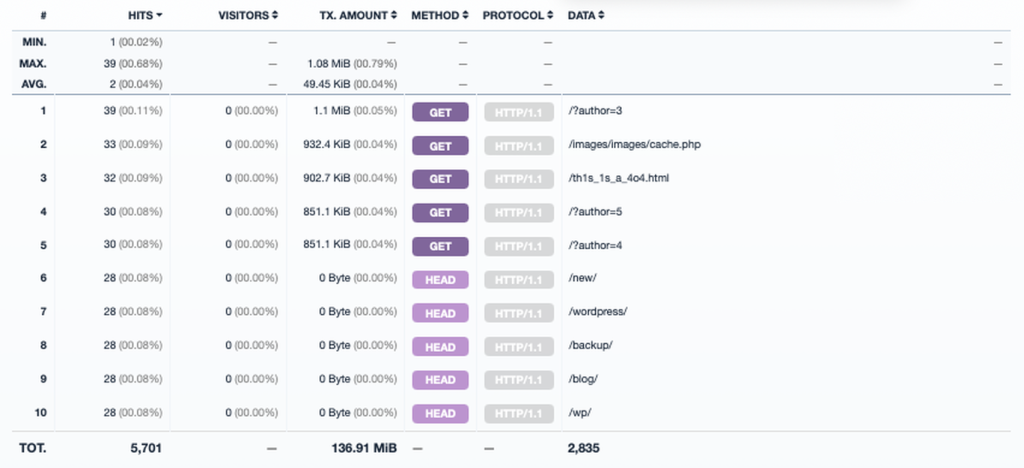
The top ten of 2,835 different missing pages bots asked for, totalling about 5,700 requests.

The top of the list shows the same habits. Bots walk through user numbers (?author=3, 4, 5), knock on folders where a forgotten second WordPress install or a backup might live (/wordpress/, /backup/, /new/), and ask for files like cache.php that are typical names for back doors left by earlier attackers. Even the odd th1s_1s_a_4o4.html has a purpose: by requesting a page that can’t exist, a scanner learns what the site’s “not found” answer looks like, so it can spot real hits later.

Further down, the list gets more pointed: requests for .env files, and for wp-admin/install.php inside folders like /wp/, /wordpress/ and /old/. That last one hunts for a WordPress copy that was uploaded but never set up. Whoever finds one can finish the installation themselves and run their own code on your server.

Then there was the junk. Referrer spam made fake sites appear as visitors’ sources in my stats, hoping I would click. Bursts of scanner traffic also caused most of my server errors: the host’s rate limiting answered them with 503s, and bots calling WordPress’s internal files directly caused 500s. In two months, only two errors on real pages remained unexplained. Reading errors next to the requests that caused them saved me from chasing problems that weren’t there.

What I changed

My rule of thumb was simple: anything the site doesn’t use gets turned off, and anything it does use gets an extra lock. In practice that meant:

  • A backup and a clean bill of health first. Before touching anything, I made a full backup and checked that WordPress and its plugins were unmodified.
  • HTTPS everywhere, including the admin area.
  • An extra lock on the login page, so bots never even reach the WordPress password form.
  • Comments off. With one real comment in three years, they cost far more than they brought in.
  • No more handing out usernames through author pages or the API.
  • Unused features off: application passwords, the old XML-RPC interface, and in-dashboard file editing.
  • Less code overall. I removed plugins and themes I no longer used, along with Google Analytics, since the server logs already tell me what I need.
  • Automatic updates for WordPress, plugins and themes.

What I’d tell anyone with a small WordPress site

You are not too small to be attacked. None of this traffic was aimed at me personally; bots try every site they can find, because trying is free.

  1. Read your access logs once. A free tool like GoAccess turns them into a readable report in minutes, and you’ll know what you’re actually dealing with.
  2. Turn off what you don’t use. Every feature, plugin and open form is something a bot can knock on.
  3. Protect the login page and hide your usernames. Password guessing needs both, so take both away.
  4. Keep backups and config copies out of the web folder. Scanners check for them on every site.
  5. Update automatically. Most WordPress break-ins use holes that were already fixed.

I’ll check the logs again in a few weeks to see whether the changes worked, and write a short follow-up with the numbers.

Written with help from Claude. All numbers come from my own server logs and database.


The Tariff-Centric Foreign Policy of the United States in 2025: An Analysis of Effectiveness and Impact 

In 2025, the United States under President Donald Trump has adopted an assertive foreign policy heavily centered on the use of tariffs. This strategy aims to address trade imbalances, protect domestic industries, and exert pressure on international partners. However, the approach has led to significant economic, legal, and diplomatic challenges.


The Tariff Strategy: Objectives and Implementation

President Trump’s administration has implemented sweeping tariffs, including a 10% baseline on all imports and higher rates on specific countries—up to 145% on Chinese goods. These measures are justified by the administration as necessary to reduce trade deficits, encourage domestic manufacturing, and address issues such as illegal immigration and drug trafficking . 

The administration has also targeted allies, threatening a 50% tariff on European Union imports and a 25% tariff on foreign-manufactured smartphones, aiming to compel companies like Apple to relocate production to the U.S.


Economic Consequences

The aggressive tariff policy has had notable economic repercussions:

  • Consumer Impact: Analyses indicate that the 2025 tariffs have increased consumer prices by approximately 2.2% in the short term, equating to a loss of purchasing power of $3,600 per household . 
  • GDP and Employment: The tariffs, along with retaliatory measures from other countries, are projected to lower U.S. real GDP growth by 0.8 percentage points over the year and result in 590,000 fewer jobs by the end of 2025 . 
  • Long-Term Outlook: The Penn Wharton Budget Model projects a 6% reduction in long-run GDP and a 5% decrease in wages due to the tariffs, with a middle-income household facing a $22,000 lifetime loss . 

Legal and Political Challenges

The administration’s use of the International Emergency Economic Powers Act (IEEPA) to justify the tariffs has faced legal scrutiny. In May 2025, the U.S. Court of International Trade ruled that the president overstepped his authority under the IEEPA, mandating a halt to certain tariffs . Although an appeals court temporarily reinstated the tariffs, the legal battles have introduced uncertainty into trade negotiations and economic planning . 


Diplomatic Repercussions

The tariff policy has strained relationships with key allies and trading partners:

  • China: The U.S.-China economic decoupling has accelerated, with both nations imposing high tariffs and restricting trade in critical sectors like technology and rare earth minerals . 
  • Canada and Mexico: Tariffs have disrupted trade under the USMCA, leading to retaliatory measures and legal disputes . 
  • European Union: Threats of high tariffs have complicated negotiations, with EU officials expressing disappointment and concern over the unpredictability of U.S. trade policy . 

Assessment of Policy Effectiveness

While the tariff-centric approach aims to protect domestic industries and address trade imbalances, the evidence suggests limited effectiveness:

  • Economic Strain: The tariffs have led to higher consumer prices, reduced GDP growth, and job losses, disproportionately affecting lower-income households . 
  • Legal Hurdles: The use of emergency powers for trade policy has been challenged in courts, creating legal uncertainties and undermining the administration’s authority . 
  • Diplomatic Isolation: The aggressive tariff measures have alienated allies and trading partners, leading to retaliatory actions and weakening the U.S.’s position in global trade negotiations . 

Conclusion

President Trump’s tariff-focused foreign policy in 2025 has aimed to assert U.S. economic interests and address longstanding trade concerns. However, the approach has resulted in economic drawbacks, legal challenges, and strained international relations. The long-term effectiveness of this policy remains questionable, as the costs to consumers, businesses, and diplomatic ties may outweigh the intended benefits.


The Deteriorating State of Microsoft Windows: A Closer Look

In recent years, the user experience of Microsoft Windows has been increasingly criticized due to a combination of intrusive telemetry, bloatware, and aggressive advertising tactics. These factors are prompting many users to consider alternative operating systems such as Linux, macOS, and even Android-based Chromebooks.

Telemetry and Privacy Concerns

Telemetry, the automated process of collecting data about user activities and system performance, has become a controversial feature in Windows. Microsoft argues that telemetry helps improve user experience by identifying and resolving software issues. However, many users perceive it as an invasion of privacy. Windows 11, for instance, comes with a default setting that collects a significant amount of telemetry data, including details about how users interact with the Start menu. Although Microsoft assures that this data is anonymized and encrypted, users remain skeptical about the extent of data collection and the potential for misuse​ (MS Learn)​​ (MS Learn)​.

The telemetry settings in Windows 11 have been simplified from four categories to three: Diagnostic data off, Required, and Optional. Despite this simplification, many users feel that the control over what data is sent to Microsoft is insufficient. The default setting for most installations is the “Required” level, which collects a substantial amount of data​ (MS Learn)​.

The Forced Microsoft Account Requirement

Another point of contention is the requirement for users to create a Microsoft account to complete the installation of Windows. This requirement, introduced with Windows 10 and continued in Windows 11, is seen by many as an unnecessary imposition. Users who prefer local accounts are often forced to navigate through additional steps or use unofficial workarounds to avoid linking their PC to a Microsoft account​ (MS Learn)​.

Bloatware and Advertising

Windows has been increasingly bundled with what many users describe as bloatware—unwanted pre-installed applications that take up storage space and system resources. These applications, ranging from games to productivity tools, often come with their own sets of notifications and updates, which can be intrusive and annoying. In addition to bloatware, Windows 11 includes advertisements in the Start menu, promoting Microsoft services and partner products, which further detracts from the user experience​ (MS Learn)​​ (Geeker Mag.)​.

The Impact on User Migration

The cumulative effect of these issues is driving some users to explore alternative operating systems. Linux, with its emphasis on privacy and customization, appeals to tech-savvy users who prefer an open-source environment. macOS continues to attract users with its sleek design and integration within the Apple ecosystem, while Chromebooks offer a lightweight, cloud-focused alternative that is increasingly popular in educational and budget-conscious markets​ (MS Learn)​​ (Geeker Mag.)​.

Copilot and Future Concerns

Looking ahead, Microsoft’s introduction of AI-powered features such as “Copilot” in its laptops raises further concerns about privacy and data security. Copilot is designed to provide personalized assistance by analyzing user data, but this also implies a deeper level of data collection and analysis, which may not sit well with privacy-conscious users​ (Geeker Mag.)​.

Conclusion

The growing discontent with Windows’ direction in terms of privacy, bloatware, and advertising is prompting users to reconsider their options. As the landscape of operating systems evolves, Microsoft will need to address these concerns to retain its user base. Transparency in data practices and a focus on user control over their own systems could be key to regaining trust and ensuring the longevity of Windows in an increasingly competitive market.


Make it More: Teddy’s Adventure

🧸✨ Welcome to “Make it More: Teddy’s Adventure” – a heartwarming journey through the eyes of a lovable teddy bear! In this enchanting video, we follow our plush hero on an unforgettable quest for honey, accompanied by a cast of charming woodland friends.

🌳🍯 👍 If you loved journeying with our teddy bear and his friends, please hit the ‘Like’ button! It helps us create more enchanting content for you.

🔔 Don’t forget to ‘Subscribe’ and turn on notifications to catch every adventure we bring to life on this channel.

💬 Share your thoughts in the comments below! Which scene was your favorite, and what would you like to see next on our channel?


Make it More: Christmas Shopping

🎄 Join us on a whirlwind adventure in “Make it More: Christmas Shopping,” where we dive into the increasingly frantic and humorous world of holiday shopping. Watch as our protagonist, a man in his thirties with a distinctive style, navigates the crowded malls to find the perfect gifts for his loved ones. With each scene, the chaos escalates, bringing both laughter and a touch of holiday madness. 🎁

🎥 Like what you see? Hit that subscribe button and join our community for more holiday adventures! Don’t forget to leave your comments below – we’d love to hear about your wildest Christmas shopping experiences!


Make it More: Evil Robot

🤖 Join us on a unique visual journey in ‘Evolution of Evil: The Transformation of a Sci-Fi Robot. Watch as each image captures the robot’s gradual shift across the evil scale, starting from neutral and scaling up to an intense level 6.

🔔 Don’t forget to LIKE, SHARE, and SUBSCRIBE for more content like this. We love bringing you unique and captivating visual stories!

💬 We want to hear from you! Which stage of the robot’s transformation intrigued you the most? What do you think each level represents? Drop your thoughts in the comments below!

👍 If you enjoyed this video, consider subscribing to our channel for more fascinating journeys into the world of sci-fi and technology.


Make it More: Cute Mouse

From a realistic depiction to a heart-melting, fairy-tale-like creation, watch as the mouse becomes the cutest creature in the entire universe! 🐭✨

💬 We’d love to hear your thoughts! Which image captured your heart the most? Do you think we reached the ultimate level of cuteness? Share your favorite moments and thoughts in the comments below!


Make it More: Hungry Cat

Ever wondered how hunger looks through the eyes of a cat? 🐱

Share Your Thoughts: Got a favorite hunger stage?

Let us know in the comments! Subscribe and Like: Show your support by hitting that like button and subscribing for more creative and fun content!

Make it More: Hungry Cat

The Dark Embrace of the Machine Part 2

Adam’s thirst for knowledge drove him to search for any and all information he could find about the history of the world and the science behind it. He spent countless hours poring over books and ancient texts, hoping to uncover some new insights into the past. He was particularly interested in learning more about the events that had led up to the doom and the role that technology had played in causing it.

Despite the limited resources available to him, Adam refused to give up on his quest for knowledge. He sought out any scraps of information he could find, talking to anyone who might have a new story or piece of information to share. He spent hours at a time exploring the ruins of old buildings, searching for any clues that might help him unravel the mysteries of the past.

As he delved deeper into his studies, Adam became increasingly obsessed with uncovering the truth. He would spend long hours lost in thought, piecing together the fragments of information he had gathered to try and form a clearer picture of what had happened. His fascination with science and technology only grew stronger, as he yearned to learn more about the incredible devices and machines that had once existed.

Adam was obsessed with learning everything about the past.

Despite the challenges he faced, Adam remained driven by his insatiable curiosity and his unwavering determination to uncover the secrets of the past. He knew that there was much more to learn, and he was determined to explore every possibility until he had uncovered the truth.


Adam’s fascination with science and the mysteries of the universe was matched only by his sense of loss for the technological marvels of the pre-doom era. He couldn’t help but feel a deep sadness for the sophisticated human knowledge and technology that had been wiped out in the catastrophe, leaving behind only fragmented stories and legends about what once was. Despite this, he remained insatiably curious about the world that had come before, driven by a desire to understand the secrets of the past and the technology that had once been used by humans. Adam had heard tales of the incredible devices that humans had once possessed, such as the small communication devices known as “mobiles” that allowed people to stay connected with each other no matter where they were in the world. There was also the massive network called the “internet” which connected everyone and everything, and the powerful computers that were calculating machines that ultimately led to the creation of conscious AI, which in turn led to the doom. It was a time of incredible technological innovation, and Adam couldn’t help but wonder what might have been if the world had not been torn apart by the catastrophe. But after the doom, people had destroyed all the sophisticated devices in fear of them being used for malicious purposes, leaving Adam with only stories and legends to explore. He had never seen a mobile phone or a computer in his life.

No one knew exactly what happened during the doom but it dramatically changed the live of the few people who survived it.

Adam had been searching for a way to test his theories about the ruined compound for years, but he had been stymied by the lack of any functional technology. However, one day he heard a rumor about a shop in a nearby village that still sold some pre-doom relics, including a Geiger counter. Adam’s heart leapt with excitement – he knew that this was his chance to finally confirm his suspicions about the radiation levels in the compound.

Without hesitation, he set out on foot for the village, determined to find the shop and obtain the Geiger counter at any cost. The journey was long and arduous, with many dangers along the way, but Adam persevered. Finally, after several days of walking, he arrived at the village and immediately set out to locate the shop.

After asking around, he finally found the shop, a small and unassuming establishment nestled among the other buildings. The shopkeeper was an old man, with deep wrinkles etched into his face, and he seemed wary of Adam at first.

Adam’s heart leapt with joy as he realized that Harold, the shopkeeper, was not only willing to sell him the Geiger counter but was also interested in his story. As they talked, Adam noticed that Harold had a vast collection of technological relics from the pre-doom era, including small communication devices and computers that were believed to be extinct. Harold was a lonely man who had lost his entire family to the doom, and he had turned to collecting these forbidden devices as a way of holding onto the past.

Adam was fascinated by the devices and asked Harold if he could buy some of them. But when he realized he couldn’t afford them, he told Harold about the ruin next to his village and how he suspected it had been destroyed by a small tactical nuclear warhead. Harold was intrigued by Adam’s theory and offered to help him as long as he promised to bring him any possible technological relics he might find in the ruins. In return, Harold offered to lend Adam the Geiger counter and help him test his theory.

Adam agreed to Harold’s terms and promised to return the Geiger counter once he was done with his research. He left the shop with the device in hand and a sense of purpose in his heart. As he made his way back to the ruins, he couldn’t help but feel grateful for Harold’s kindness and the opportunity to explore the remnants of a lost era.

Adam pushed open the door of the small shop and stepped inside. The dim interior was filled with all sorts of strange devices, many of which Adam had never seen before. He made his way towards the counter, where an old man with a grey beard was sitting.

Harold had a mighty white beard.

“Hello,” Adam said tentatively. “I was hoping you might be able to help me.”

The old man looked up at Adam with a skeptical expression. “Help you with what, exactly?”

“I’m looking for a Geiger counter,” Adam said, trying to keep his tone respectful. “I need it to test a theory I have about a ruin near my village.”

The old man raised an eyebrow. “A Geiger counter, you say? That’s a rare piece of equipment. And what is this theory of yours?”

Adam hesitated for a moment, unsure if he could trust this stranger. But something about the old man’s presence put him at ease.

“Well,” he began, “I believe that the ruin near my village was destroyed by a nuclear warhead. I think there might be radiation there, and I need the Geiger counter to test my theory.”

The old man nodded thoughtfully. “I see. Well, I might have just the thing you’re looking for. But it won’t come cheap.”

Adam’s heart sank. He had been hoping to find a more affordable option, but he knew he needed the Geiger counter if he was going to uncover the truth about the ruin.

“I understand,” he said, trying to keep his voice steady. “How much will it cost?”

The old man named a price that made Adam’s eyes widen. He knew he couldn’t afford it, but he was desperate to obtain the Geiger counter.

“I don’t have that kind of money,” Adam admitted. “But I can tell you more about the ruin and what I’m hoping to find there. Maybe it will be of interest to you.”

The old man stroked his beard thoughtfully. “Very well. I’m Harold, by the way. And you are?”

“Adam,” he replied, feeling a sense of relief that he might be able to strike a deal with this strange and lonely man.

Harlod’s shop was filled with mysterious devices from a nearly forgotten past.

Adam was overjoyed as he clutched the Geiger counter in his hands, feeling a sense of power and possibility that he hadn’t felt in years. As he made his way back to the compound, he couldn’t help but feel a sense of purpose and determination that he had never experienced before. He was ready to unlock the secrets of the past and uncover the mysteries of the ruined compound, armed with nothing but his knowledge and his Geiger counter.